kotte heritage Foundation
Safeguarding the Forgotten Fortress for Future Generations
Welcome to the
Kingdom of Kotte
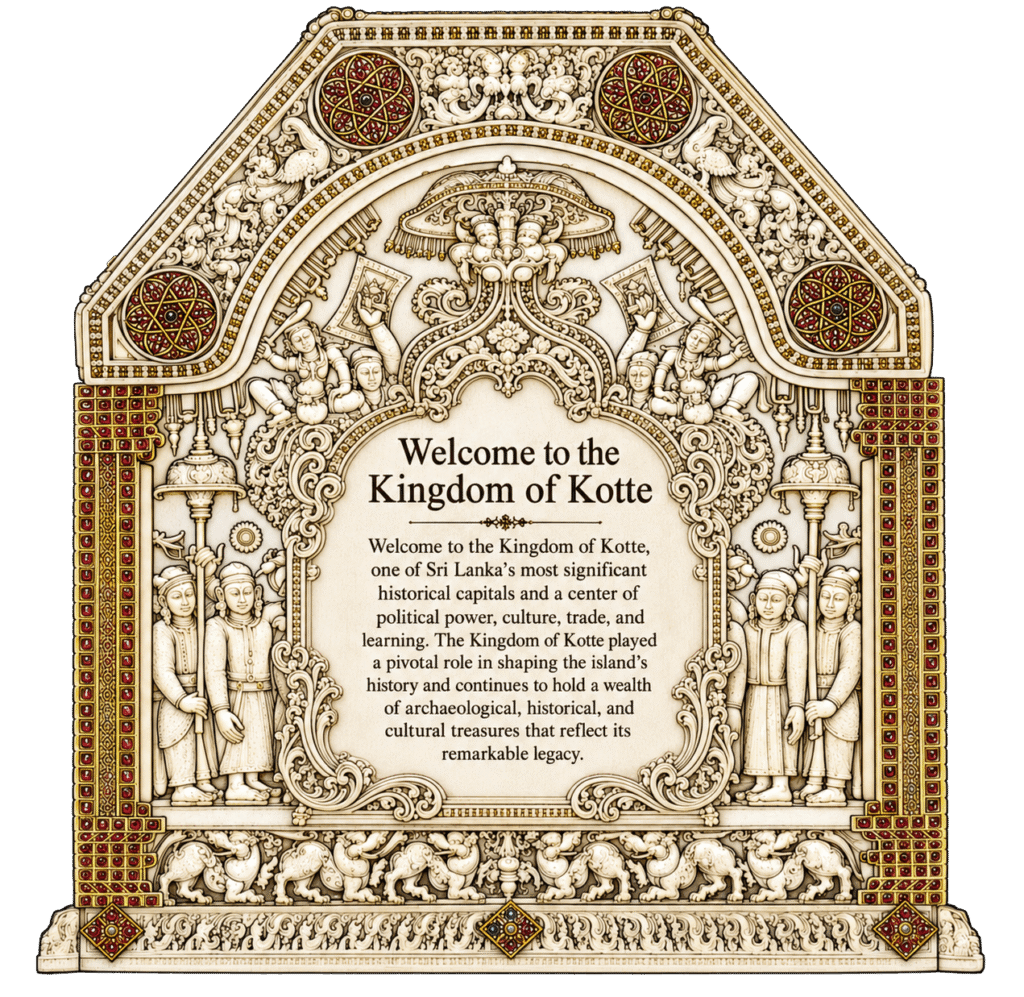
Welcome to the Kingdom of Kotte, one of Sri Lanka’s most significant historical capitals and a center of political power, culture, trade, and learning. The Kingdom of Kotte played a pivotal role in shaping the island’s history and continues to hold a wealth of archaeological, historical, and cultural treasures that reflect its remarkable legacy.
Kotte Heritage...
History of the Kingdom of Kotte
The Kingdom of Kotte was the last great indigenous kingdom to exercise sovereignty over the whole island of Sri Lanka before the arrival of European colonial powers. Rising to prominence in the late 14th century and reaching its zenith under King Parākramabāhu VI, Kotte became one of the island’s greatest political, military, and cultural capitals, leaving a legacy that continues to shape Sri Lankan heritage today.
15th Century
The Rise of a Royal Capital
In 1415, King Parākramabāhu VI was consecrated at Kotte, establishing it as the capital of the kingdom. The city was strategically situated on a naturally fortified site, protected by the Diyawanna Oya, the Kolonnawa marshes, and an elaborate system of moats, ramparts, and waterways. These formidable defences made Kotte one of the most secure royal capitals in Sri Lankan history.
15th Century
The Golden Age of Kotte
During the 15th century, under the reign of Parākramabāhu VI, the Kingdom of Kotte reached its Golden Age and exercised sovereignty over the whole island of Sri Lanka. This period was marked by political stability, military strength, and remarkable achievements in administration, religion, literature, architecture, and the arts.
Royal patronage fostered the flourishing of Sinhala literature, Buddhist scholarship, temple construction, and traditional craftsmanship. Many of the cultural traditions established during this era continue to influence Sri Lankan identity today.
15th Century
A Thriving Centre of Trade
Kotte was also a vibrant international trading centre that connected Sri Lanka to the wider Indian Ocean world. Merchants from India, Arabia, China, and Southeast Asia visited its ports, trading in cinnamon, spices, gemstones, elephants, textiles, and other valuable commodities.
Its strategic location and commercial prosperity made Kotte an important hub of maritime commerce and diplomacy, attracting traders and envoys from across Asia.
16th Century
The Portuguese Era and the Shift of Political Power
The arrival of the Portuguese in 1505 marked a profound turning point in the history of Kotte. Internal dynastic rivalries, combined with growing Portuguese intervention in local politics, gradually weakened the authority of the kingdom.
In 1565, following the abandonment of Kotte, the Portuguese transferred their administration, together with King Dharmapala, to Colombo, which subsequently became the centre of Portuguese colonial administration. The Sinhala political centre shifted to Sitāvaka. Following the decline of the Kingdom of Sitāvaka, political authority was subsequently established at Kandy in 1594.
This transition is therefore more accurately understood as a sequence of political shifts: Kotte → Sitāvaka → Kandy, rather than as a direct transfer of political power from Kotte to Kandy.
Kotte Today
Although much of the medieval capital now lies beneath the modern city of Sri Jayawardenepura Kotte, its remarkable heritage remains embedded within the landscape. Ancient ramparts, defensive moats, archaeological remains, royal precincts, and historic sites continue to reveal the sophistication of Kotte’s urban planning and military engineering.
Ongoing historical and archaeological research continues to uncover new insights into the city’s hidden past, offering a deeper understanding of one of Sri Lanka’s greatest kingdoms.
Featured Article of the Month
Ivory Caskets and the Diplomacy of Kotte
Hidden within some of Europe’s great museum collections are remarkable objects that tell stories reaching far beyond their physical beauty. Among them are a small number of exquisitely carved ivory caskets created in the Kingdom of Kotte during the 16th century.
Life and Times in Kotte
Discover daily life in the Kingdom of Kotte—from its magnificent royal court and bustling international markets to Buddhist learning, traditional crafts, military strength and colourful festivals. Explore how this prosperous medieval capital shaped Sri Lanka’s cultural heritage and uncover the archaeological remains still hidden beneath modern Sri Jayawardenepura Kotte.
Might’s and legends
Discover the myths and legends surrounding Kotte’s mysterious underground tunnels, hidden passages and tales of royal treasures. Passed down through generations, these stories blend history with folklore, revealing secret escape routes, forgotten entrances and unexplored chambers beneath modern Sri Jayawardenepura Kotte.
Might’s and legends
Discover the myths and legends surrounding Kotte’s mysterious underground tunnels, hidden passages and tales of royal treasures. Passed down through generations, these stories blend history with folklore, revealing secret escape routes, forgotten entrances and unexplored chambers beneath modern Sri Jayawardenepura Kotte.
Map of the Fortress of Kotte
Places to Visit at the Fortress of Kotte
Veherakanda
Ramparts Baddegana
Ananda Sastralaya Stupa
Ramparts Angampitiya
Kotte by Foot
Explore Kotte and beyond through guided tours organised by the Kotte Heritage Foundation. From heritage walks through historic Kotte and city tours of Colombo to nature excursions and boat safaris to Hanwella, each journey is designed to reveal the region’s history, culture and natural beauty.
Latest News & Events
Member Registration
Become a valued member of our community and stay connected with our latest activities, events, projects, and important updates. By registering, you can take part in our initiatives, contribute your ideas, and help us build a stronger and more connected community.
Make a Donation
Your support can make a meaningful difference. Every donation helps us continue our activities, support valuable projects, preserve our shared values, and create more opportunities for the community. Your contribution, big or small, is greatly appreciated and helps us move forward together.
Make a Donation
Lorem ipsum dolor sit amet, consectetur adipiscing elit. Ut elit tellus, luctus nec ullamcorper mattis, pulvinar dapibus leo. Lorem ipsum dolor sit amet, consectetur adipiscing elit. Ut elit tellus, luctus nec ullamcorper mattis, pulvinar dapibus leo.Lorem ipsum dolor sit amet, consectetur adipiscing elit. Ut elit tellus, luctus nec ullamcorper mattis, pulvinar dapibus leo. Lorem ipsum dolor sit amet, consectetur adipiscing elit. Ut elit tellus, luctus nec ullamcorper mattis, pulvinar dapibus leo.
Contact Us
Kotte Heritage Foundation
622/9, Ethul Kotte, Sri Lanka
Email: info@kotteharitage.com
WhatsApp:
Comments and Suggestions
We value your feedback. Share your comments and suggestions to help us improve.
Legal Information
Registration Number
Sri Japura/Admin/07/N.G.O./136
Date of Establishment
Saturday 9th May 2015
Date and Time
Copyright © 2025 Kotte Heritage. All Rights Reserved.