Hidden within some of Europe’s great museum collections are remarkable objects that tell stories reaching far beyond their physical beauty. Among them are a small number of exquisitely carved ivory caskets created in the Kingdom of Kotte during the 16th century.
These caskets were more than luxurious containers. They were expressions of royal prestige, extraordinary Sri Lankan craftsmanship and, most importantly, instruments of diplomacy at a time when the Kingdom of Kotte was establishing increasingly complex relations with Portugal. Historical research records that elaborate ivory caskets were among the most prestigious gifts sent from Kotte to Portuguese rulers and officials.
Kotte at the Crossroads of the Indian Ocean
During the 16th century, Kotte stood at the centre of a kingdom strategically located along the maritime routes of the Indian Ocean.
Sri Lanka had long been connected to international trade, while its cinnamon, gems and other valuable commodities attracted merchants from across Asia and beyond. The arrival of the Portuguese in the early 1500s introduced a powerful new maritime force into this already interconnected world. Portuguese contact with Sri Lanka began in 1505, and their commercial and political involvement increased during the following decades.
For the rulers of Kotte, relations with Portugal were not simply about trade. They became part of a complicated political strategy involving royal succession, military alliances and competition with neighbouring kingdoms.
King Bhuvanekabahu VII, who ruled Kotte from 1521 to 1551, sought Portuguese assistance as he attempted to secure his position and protect the succession of his grandson, Prince Dharmapala. A diplomatic mission from Kotte travelled to Lisbon in the early 1540s, where Dharmapala was symbolically recognised through a royal coronation ceremony conducted by King João III of Portugal.
It was in this world of negotiation and royal diplomacy that Kotte’s extraordinary ivory caskets acquired their importance.
A Message Carved in Ivory
The Diplomat’s Casket demonstrates the sophistication of the craftsmen who worked within the cultural world of the Kotte court.
Its surface is transformed into a complex field of intertwined vegetation, animals, human figures and symbolic forms. Instead of leaving the ivory as a plain luxury material, the craftsmen turned almost every available space into a visual narrative.
The video draws particular attention to several traditional decorative elements.
Liyavel appears as a flowing, interconnected vine. Its continuous movement across the surface creates a sense of life, growth and connection.
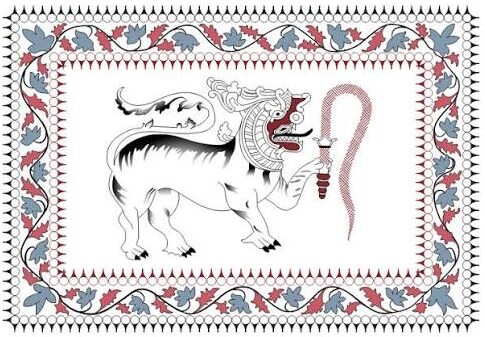
The Sina-mal, represented through a symmetrical lion-like face, is presented as a protective symbol associated with royal authority.
The small Ganas, depicted almost like acrobatic dwarf figures supporting the structure, add another layer of symbolism to the casket’s design.
Together, these motifs transform the object from a simple box into something resembling a miniature royal monument. The imagery communicates protection, prosperity, continuity and power.
The Skill of Kotte’s Ivory Craftsmen
Creating an object of this complexity demanded exceptional technical ability.
Sri Lanka had developed a distinguished tradition of ivory carving long before sustained European involvement. Historical studies describe Sri Lankan artists producing intricate religious and decorative ivory works and adapting their craftsmanship for different patrons. By the 16th century, the workshops associated with Kotte were capable of producing sophisticated caskets incorporating both deeply rooted Sri Lankan forms and imagery responding to European tastes.
The finest diplomatic caskets combined carefully carved ivory with precious materials, including gilded metalwork and gemstones. Surviving examples demonstrate just how highly valued these objects were at European courts.
The video imagines the craftsmen planning the casket, preparing the ivory and painstakingly carving its detailed surfaces. This helps us appreciate something easily forgotten when viewing the finished object in a museum: behind every tiny figure, curling vine and decorative border were the hands of highly skilled Sri Lankan artisans.
An Object of Diplomacy
The true significance of the casket lies in what it represented.
Diplomatic gifts were political statements. A gift from the King of Kotte to an important Portuguese ruler or official communicated the wealth of the kingdom, the sophistication of its court and the extraordinary abilities of its craftsmen.
Historical evidence records several important Kotte ivory caskets entering Portuguese royal and aristocratic circles. King Bhuvanekabahu VII is recorded as presenting four ivory caskets to the Portuguese monarch, helping create wider European interest in Sri Lankan ivory craftsmanship.
Another particularly important example was presented in 1547 to Dom João de Castro, the Portuguese statesman and Viceroy of Portuguese India. That casket eventually entered the collections of what is now the Kunsthistorisches Museum in Vienna.
The exchange therefore carried a message far greater than the object itself:
Kotte was presenting its culture to the wider world.
When Two Artistic Worlds Met
One of the most fascinating aspects of the surviving Kotte caskets is the way their decoration changed as relations with Portugal developed.
Earlier examples contain strongly Sri Lankan religious, royal and literary imagery. Later works increasingly combine local artistic traditions with European and Christian subjects. Researchers have identified scenes from Sri Lankan and South Asian traditions alongside imagery influenced by European prints and Christian stories.
The famous Robinson Casket, now held by the Victoria and Albert Museum in London and dated to around 1557, is an extraordinary example. Its carvings combine biblical subjects with Sri Lankan dancers, musicians and decorative traditions, revealing how local craftsmen interpreted unfamiliar European imagery through their own artistic language.
These objects therefore document something much larger than artistic fashion. They preserve evidence of one of the earliest sustained cultural encounters between Sri Lanka and Renaissance Europe.
From Kotte to the Great Collections of Europe
The journey of these caskets did not end with the diplomatic missions that carried them across the Indian Ocean.
Once they reached Portugal, their rarity and craftsmanship made them desirable objects among European royal and aristocratic families. Some eventually entered major collections in places such as Vienna, Munich and London. Several related Kotte caskets have remained in European aristocratic or museum collections for centuries.
Today, thousands of kilometres from the place where they were created, they continue to preserve fragments of the lost royal world of Kotte.
Their survival is particularly significant because comparatively little remains above ground of Kotte’s great palaces, workshops and royal buildings. These portable masterpieces therefore provide another way of understanding the sophistication of the kingdom.
More Than a Casket
At first glance, the Diplomat’s Casket is a beautiful small object.
Look closer, however, and it becomes something much more significant.
It represents the hands of Sri Lankan craftsmen capable of producing work admired by some of the most powerful courts of 16th-century Europe. It reflects a kingdom attempting to navigate a rapidly changing political world. It preserves traditional Kotte symbolism while revealing the beginnings of new artistic influences arriving across the sea.
Most importantly, it reminds us that the Kingdom of Kotte was not isolated.
It belonged to a much larger world connected by merchants, ambassadors, ships, royal courts and ideas moving across the Indian Ocean and into Europe.
More than four centuries later, the surviving ivory caskets of Kotte continue to speak for that world — small masterpieces carrying an extraordinary story of Sri Lankan craftsmanship, kingship and diplomacy across continents.